Breathing With Trees asks a simple thing: sit or stand with a plant, and breathe deliberately, attending to the literal exchange of oxygen and carbon dioxide passing between you. In a workshop flow, this process can function as a linking and grounding piece between an Honouring Pain for the World process (such as the Truth mandala or Cairn of Mourning) and “seeing with New Eyes. It can also be a regular personal practice - connecting :seeing with new eyes” to basic breath awareness practices
The practice, and why it works
Everyone turns to something green — a blade of grass, a single branch, a whole tree, a forest. Focus on your breath. You may bring your attention explicitly to the in-oxygen, out-carbon-dioxide exchange, or hold that lightly in the back of your awareness while simply staying present with the green, photosynthesizing being in front of you. Do this for five to seven minutes, then return to circle and share any insights — in pairs first, if time is short.
It’s worth naming, before or after, why this exercise matters: we have far more developed relationships with other human beings, with technology, with consumerism and its various addictions, than we do with the living world around us. When it comes to spending time with nature and actually learning from it, we often find ourselves shutting down or fleeing mentally. This exercise is a chance to notice that pattern, and to give a little time back to the relationship underlying all our others. During it, no one should worry about doing it “right” — however it works out is fine. Just stay as present as you can with the tree, letting thoughts come and go.
The sympathy of chlorophyll and haemoglobin
Haydn Washington, October 2017.
We forget the wonder of our daily breathing and how it ties us into the amazing interaction of photosynthesis (creating food from light and CO₂) in plants and respiration (breaking down sugars and starches to create energy) in animals. We tend to think of ourselves as “so different” from plants — yet we share much in common, as we shall see. The first is two key molecules in the dance of life: chlorophyll and haemoglobin (and haemocyanin, in arthropods, molluscs and cephalopods).
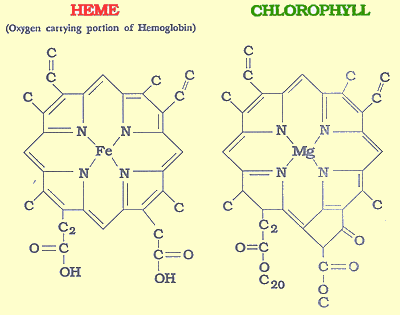
The haeme group in haemoglobin binds an atom of iron, and this binds oxygen in our lungs and releases it throughout our bodies (haemocyanin is structurally a bit different, and uses copper to bind oxygen instead). In plants, a very similar structure to haeme binds an atom of magnesium, and it is this that allows photosynthesis to take place, where water is split to take the hydrogen ions and combine them with CO₂ to make sugars — which can then be stored as starch. The by-product of this is something essential to us: oxygen. So I, as a red-blooded human using haemoglobin, and the green plant using chlorophyll, are both built around a very similar molecule.
Even more wondrous, the fundamental processes of animal and plant life take place in cellular “organelles” that were once free-living bacteria — we know this because they still contain their own bacterial DNA — which, through symbiosis, became part of our cells, whether we are plants or animals. This was perhaps the single greatest cooperative event in the history of life, where two different kinds of organism came together to become one, allowing the evolution of the plants and animals of today. In plants these key structures are called chloroplasts, which produce the sugars and oxygen that power life. In animals they are mitochondria (plants have these too) — the powerhouses of our cells, where sugars are broken back down to CO₂ and water.
John Seed places this reciprocity in a still deeper timeframe. In his telling of the Cosmic Walk, the very oxygen we now breathe was, 3.9 billion years ago, a toxin — the waste product of the first photosynthesizing autotrophs, pumped into the atmosphere in such volume that it threatened to poison all existing life. It took some 1.2 billion years before heterotrophic cells evolved a use for it — inventing, in effect, our own mode of metabolism as a survival response to the autotrophs’ pollution. Every breath in this meditation is a living echo of that ancient crisis and its resolution: the plant still pumping out what was once a poison, and us still breathing it in because our own ancestors, billions of years ago, found this amazing way not only to survive it, but make it useful.
Meditation
Face a plant in sunlight. Focus on your breathing — breathe in, breathe out, for a minute or two. Then consider the similarity of our haemoglobin and the plant’s chlorophyll. Visualize the structure of your lungs, containing a series of fine sacs called alveoli. Your blood system brings CO₂-rich blood to the lung surface, where the CO₂ is released into the lung cavity.
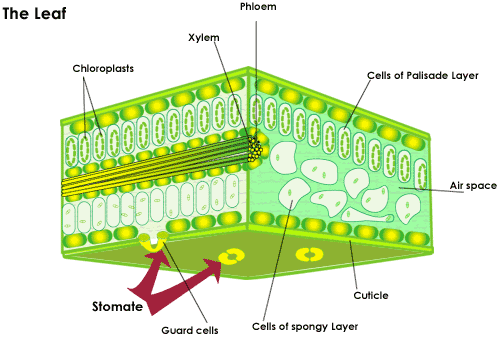
Now consider the plant in front of you. In a leaf there are pores called stomata, mostly open but able to close — in drought, for instance, to save water. The average leaf has about 300 stomata per square millimetre of surface. CO₂ moves through these into the air spaces of the spongy layer, then to the palisade cells just below the leaf’s top surface. These are packed with green chloroplasts, which contain stacked disc-like structures called “grana” — like stacks of coins.
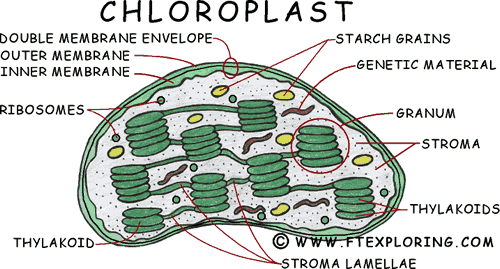
The grana discs hold the chlorophyll, where light energy is used to split water and bind the freed hydrogen atoms to the CO₂ you breathed out, making sugars — which can then be turned into starch (potatoes, grains) or into cellulose, to make wood.
Reach out and hold a leaf. Breathe out — visualize the CO₂ that was in your lungs fanning out over the leaf, passing through its stomata, moving to the palisade cells, and diffusing into the chloroplasts. There, in the sunlight, by the magic of photosynthesis, water is split, and “your” CO₂ is added to the freed hydrogen atoms to make the sugars that power the plant — and, through it, everything that eats the plant, the whole ecosystem. Now visualize the oxygen this releases flowing back out of the chloroplasts, out through the stomata, into the air — and breathe it in. That oxygen diffuses across your lung membranes into your bloodstream, binds to the haemoglobin in your red blood cells, and travels through your circulatory system to every cell in your body, where it diffuses into the mitochondria and the enzymes of respiration break sugars back down into CO₂ and water, producing the ATP molecule that powers your cells.
Open your eyes. Look now at the leaf you’re holding, and at all the green plants around you. Through your breathing, and the deep synchronicity of two similar molecules — chlorophyll and haemoglobin — you have just taken part in the dance of life, both giving and receiving. Perhaps plants are not so different from us as you once thought. Finish your meditation with thanks for our cousins — the green plants that give so much to the living world.